
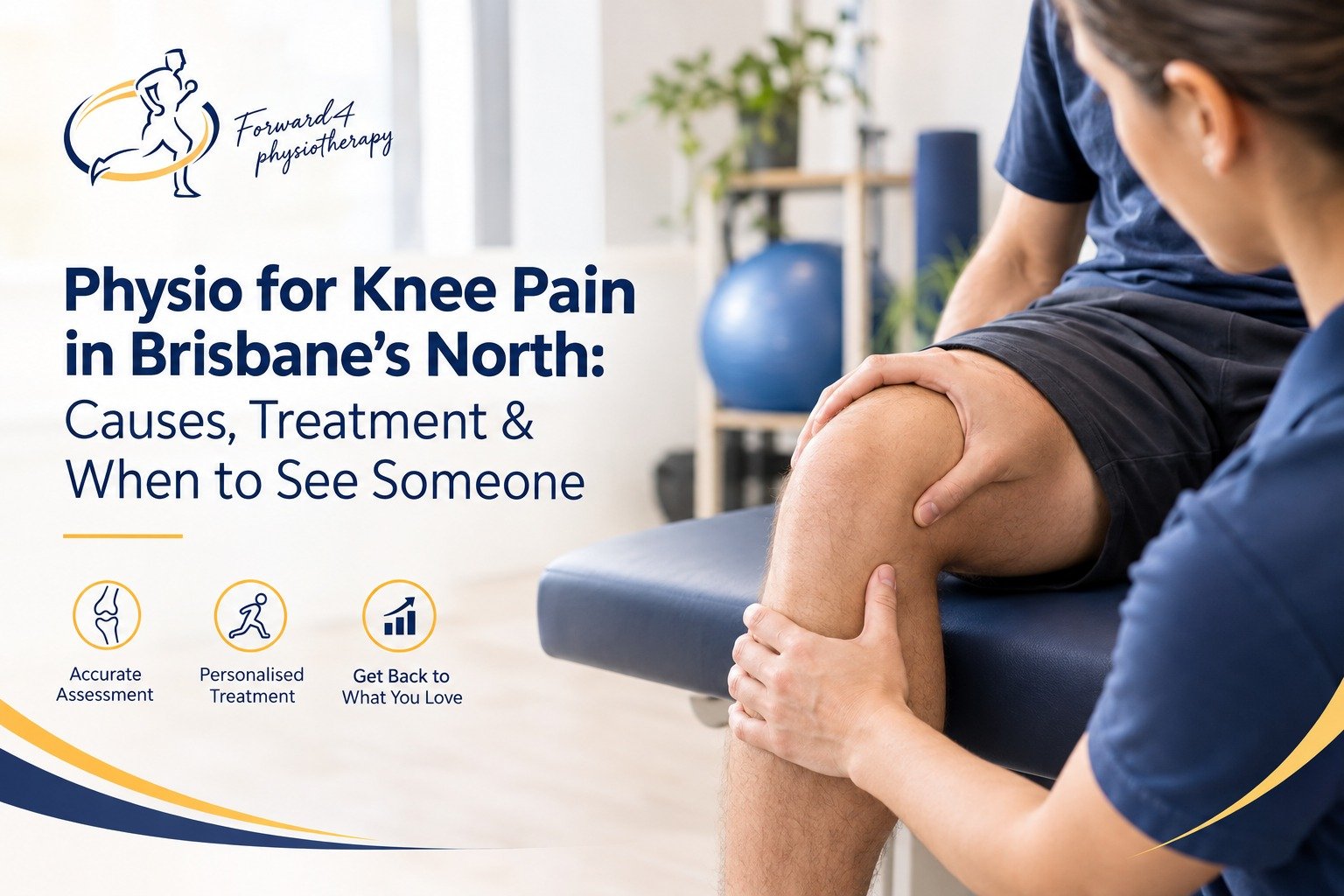
Knee pain can be frustrating because the knee is involved in almost everything from getting out of a chair to walking, running, climbing stairs and playing sport. Some knee problems appear suddenly after a twist, fall or awkward landing. Others build gradually until you notice that squatting, standing for long periods or walking downhill is no longer as comfortable as it used to be.
If you are looking for physio for knee pain in Brisbane’s north, it helps to understand that knee pain is a symptom rather than a diagnosis. The right treatment depends on what is causing the problem, how irritable the knee is, what activities you need to return to and whether there are any signs that require medical investigation.
Common causes of knee pain
Knee pain can come from the joint itself or from structures around it. A physiotherapist will usually consider the location of pain, how it started, swelling, movement, strength, activity level and any history of injury before deciding what is most likely.
- Patellofemoral pain, often felt around or behind the kneecap and commonly aggravated by stairs, squatting or running.
- Sprains and ligament injuries after twisting, changing direction or contact during sport.
- Meniscus related symptoms, which can follow a twist or develop with age related changes in the knee.
- Tendon problems caused by repeated loading, jumping, running or sudden increases in exercise.
- Osteoarthritis, which can cause pain, stiffness and reduced function, particularly with age or after previous injury.
- Bursitis or irritation of tissues around the knee after kneeling, overuse or direct pressure.
- Muscle weakness, reduced hip control or changes in training load that place more stress on the knee than it is ready to tolerate.
Clicking by itself does not always mean something is damaged, and pain intensity does not always tell you how serious a condition is. That is why an individual assessment is more useful than trying to diagnose the problem from one symptom alone.
What does a physiotherapist assess for knee pain?
A knee assessment usually starts with your story. Your physiotherapist may ask whether the pain came on suddenly or gradually, whether the knee swells, whether it locks or gives way, and which movements are difficult. They may then look at knee range of motion, muscle strength, walking, balance and functional movements such as a squat, step down or single leg task.
Depending on the problem, they may also assess the hip, ankle and the way you move during the activity that triggers your pain. For runners or athletes, training volume, recent changes in intensity and recovery can be just as relevant as the knee itself.
How physiotherapy can help knee pain
Physiotherapy treatment is normally matched to the cause and stage of the problem. For many knee conditions, exercise is a central part of rehabilitation. The goal is to restore useful movement and build the capacity of the muscles around the knee and hip so everyday activities place less strain on sensitive tissues.
- Strengthening exercises that progress as the knee tolerates more load.
- Mobility work when stiffness is limiting normal movement.
- Balance and control exercises after injury or when the knee feels unstable.
- Advice on modifying painful activities without unnecessarily stopping all movement.
- Gradual return to walking, running, gym training or sport.
- Taping, bracing or other short term supports when they are appropriate for the individual.
- Education about flare ups, pacing and how to judge whether an exercise load is suitable.
For knee osteoarthritis, strengthening and lower impact exercise can be useful parts of management. Weight management may also reduce load on the knee for some people. For an acute injury, early treatment may focus more on protecting the knee, controlling swelling and restoring comfortable movement before heavier strengthening begins.
Should you rest a painful knee?
Complete rest is not automatically the answer. A short reduction in activities that clearly aggravate symptoms can be sensible, particularly after a recent injury, but long periods of inactivity may lead to loss of strength and confidence. In many cases the better approach is relative rest, where you keep moving within a tolerable range and gradually rebuild activity.
A physiotherapist can help you decide what to continue, what to temporarily reduce and how quickly to progress. This is particularly useful if you have been stuck in a cycle of feeling better, doing too much, flaring up and then stopping again.
When should you see someone about knee pain?
Book an assessment if knee pain is persisting, repeatedly returning, affecting sleep or daily function, or stopping you from exercising normally. It is also sensible to seek help if you are unsure how to return to activity after an injury or if you have swelling, weakness or a feeling that the knee may give way.
Seek prompt medical assessment if you cannot put weight through the leg, cannot move the knee normally, the knee is very painful after a significant injury, or it is badly swollen or has changed shape. A hot, red and swollen knee accompanied by fever needs urgent medical attention.
Knee pain physio in Mango Hill
Forward 4 Physiotherapy in Mango Hill works with people experiencing knee pain, sports injuries, post operative rehabilitation and movement limitations. Treatment is based on assessment rather than a standard template, with the aim of helping you understand the problem, improve function and build confidence in movement again.
If knee pain has started changing the way you walk, train or manage everyday tasks, you do not need to wait until it becomes severe before getting it assessed. An early plan can help you make better decisions about activity and give you a clearer path back to the things you want to do.